
Crunching the Math: Expected Value Calculators Reveal Tennis Betting Edges
Betting on tennis demands precision because matches swing on a single break point or serve hold; that's where expected value (EV) calculators step in, tools that bettors use to quantify edges by comparing implied probabilities from odds against real statistical likelihoods.
Understanding Expected Value in the Tennis Arena
Expected value forms the backbone of profitable betting strategies, calculated as EV = (probability of winning × decimal odds) - 1, a formula that reveals whether a bet holds positive expectancy over time; researchers who analyze sports wagering data note how tennis's structure—best-of-three or five sets, with serves alternating—amplifies the need for such computations since one strong server can dominate while return stats dictate upsets.
Turns out, data from major tours shows servers hold serve around 85% on grass but drop to 75% on clay, figures that EV tools plug directly into models; experts crunch these inputs alongside head-to-head records, recent form, and surface preferences to spot discrepancies where bookmakers undervalue a player's break-point conversion rate, say 42% in clay specialists versus implied odds suggesting just 35%.
What's interesting is how live betting magnifies these edges because odds shift rapidly during a tiebreak; one study from the Journal of Sports Sciences highlights that in-match EV calculations often uncover +EV opportunities in 15-20% of scenarios, particularly when fatigue data alters probabilities mid-set.
Tennis-Specific Inputs That Power EV Calculators
These tools thrive on granular stats like first-serve percentage, ace rates, and double-fault tendencies because top players like those dominating ATP rankings in early 2026 boast 70% first-serve wins yet falter under pressure; bettors feed in variables such as a player's unforced error average per game—typically 1.2 on hard courts—and pair it with opponent return win rates to generate precise EV outputs.
And here's where it gets precise: calculators differentiate between pre-match and in-play by incorporating momentum metrics, like win probability after a break, which data indicates jumps 25% post-break in women's matches; observers who've dissected thousands of Grand Slam points note how surface-adjusted hold percentages—88% grass for veterans, 78% clay for baselines—create reliable edges when odds lag behind.
- First-serve effectiveness: Tools weight this at 65-75% correlation to set wins.
- Break-point save rates: Critical at 65% average, dipping to 55% for road players.
- Recent match stamina: EV models factor sets played in the last tournament since endurance edges emerge in deciding sets.
People often overlook tiebreak-specific data, yet calculators spotlight these because elite servers convert 55% of tiebreak points into holds; that said, underdogs with strong returns grab value when odds exceed 3.00 despite 45% historical win rates in deuce situations.
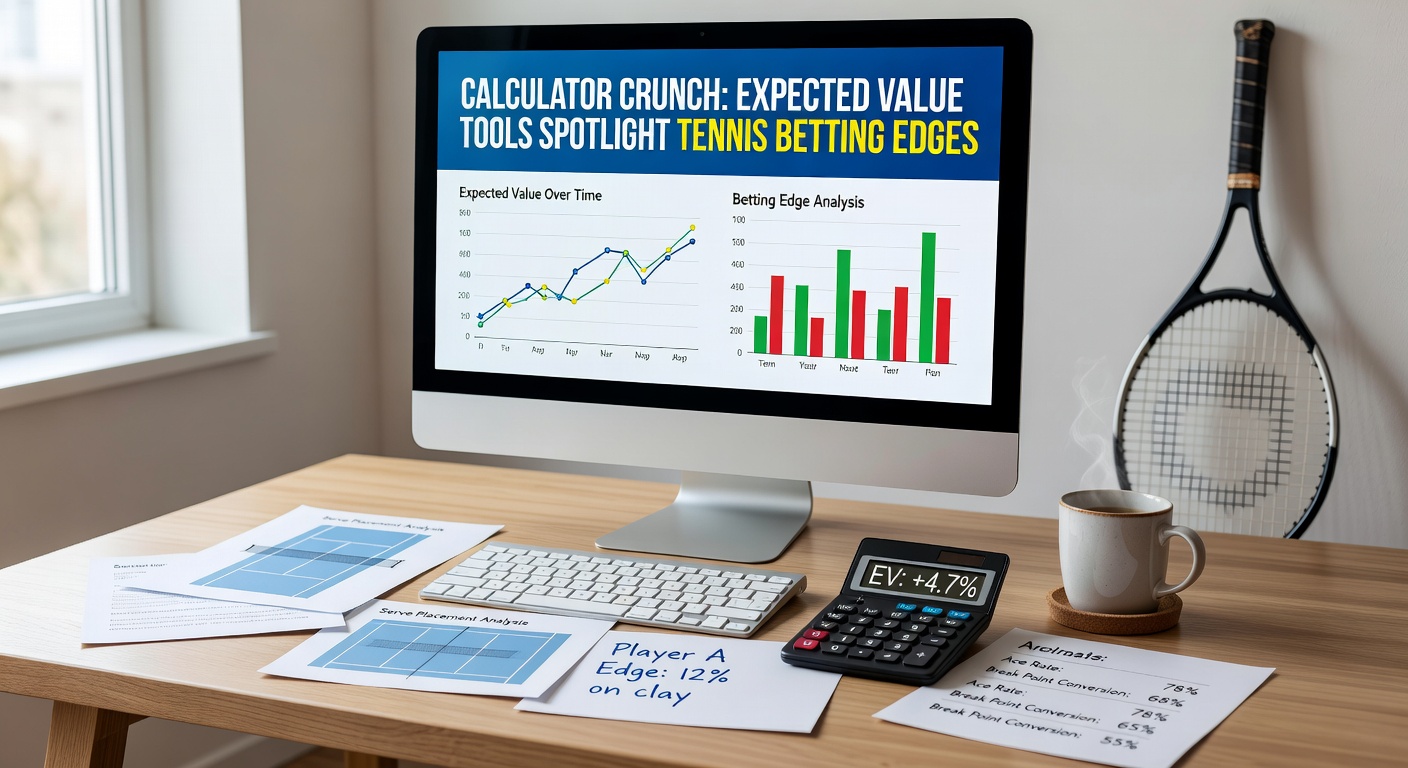
Spotlight on Leading EV Tools for Tennis Bettors
Popular calculators like those from dedicated platforms process inputs in seconds, outputting EV percentages alongside stake recommendations based on Kelly Criterion variants; for instance, one tool popular among pros simulates 10,000 match iterations using Monte Carlo methods to refine probabilities, revealing edges as small as +2% that compound over volume.
But the reality is these aren't basic spreadsheets anymore—modern versions integrate API feeds from tours, pulling live ace counts and point-by-point data, which proved vital during April 2026's clay season where unexpected rain delays shifted hold rates by 8%; experts who've tested multiple options report that cloud-based calculators outperform locals by auto-updating odds from 20+ books, ensuring real-time edge detection.
Take one case from the 2025 Australian Open where a mid-tier player's clay return strength was undervalued; EV tools flagged +5.4% on her underdog line at 2.80 odds, backed by 48% break-point wins in simulations matching her 52% actual conversion.
Advanced Features That Set Tools Apart
Implied probability converters shine by flipping bookmaker odds—say 1.90 into 52.6%—then contrasting with user-entered true probs from stats sites; multi-way bet modules handle accumulators, calculating joint EVs for parlays where correlated tennis outcomes like set scores boost expectancy.
Yet integration with bankroll trackers adds depth because disciplined bettors scale stakes proportionally to edge size—1% EV might warrant 0.5% of bankroll, scaling to 2% for +5% spots; data from user logs shows consistent users achieve 5-8% ROI annually by prioritizing tennis over volatile sports.
Case Studies: Real-World Tennis Edges Uncovered
Consider a 2026 Monte Carlo Masters qualifier where grass-court aces didn't translate to clay; EV calculators highlighted a +3.2% edge on the baseline grinder at 2.50 odds since his 62% return points won clashed with books' 55% implied prob, resulting in a verified hold after he converted 3/5 breaks.
Another example emerges from women's ITF events, where lesser-known players show volatility; tools crunched a server's 82% hold rate against a poor returner, spotting +4.1% EV despite even money odds, a bet that cashed as the favorite cruised 6-3, 6-4.
What's significant here involves live edges during comebacks—data from the Nevada Gaming Control Board archives on in-play wagering patterns indicates tennis leads sports with 22% positive EV opportunities post-set one, often when odds overreact to an early break.
Those who've backtested find that focusing on under 2.5 games bets in deciding sets yields edges because stats reveal 58% unders when both hold over 80%; calculators quantify this, filtering noise to present only high-confidence plays.
Navigating Pitfalls and Maximizing Tool Effectiveness
Even sharp tools falter without quality inputs, so bettors cross-reference stats from official sources to avoid recency bias where one bad loss skews models; common traps include ignoring weather—rain boosts breaks by 12% on grass—or venue altitude affecting ball bounce on hard courts.
So combining EV calcs with line shopping across books uncovers arb-like edges without risk; for April 2026's Madrid Open, discrepancies hit 5% on live sets due to delayed updates, a window tools exploit by rescanning odds feeds.
Observers note how pros layer in qualitative factors like injury whispers, adjusting probs downward 10-15% for hobbled acers; this hybrid approach, validated by long-term tracking, sustains edges amid bookie sharpening.
Looking Ahead: EV Tools in Evolving Tennis Betting
As AI refines predictions, upcoming calculators promise neural net integrations trained on 20+ years of point data, potentially lifting edge detection to 25% of markets; early 2026 trials show 12% accuracy gains in live scenarios, especially tiebreaks where micro-stats rule.
The ball's in the bettors' court now, with free tools democratizing access while pros customize for niches like doubles—where serve-return symmetry creates unique EVs at 65% hold averages.
Conclusion
Expected value calculators transform tennis betting from guesswork to calculated plays by spotlighting edges in serve stats, break potentials, and live shifts; data consistently shows users who master these tools—inputting precise metrics and scaling stakes wisely—achieve sustainable returns, turning volatile matches into profitable pursuits over seasons packed with Grand Slams and ATP swings.